SOLO EXHIBITION
Peny Manavi
Automn Symphony
October 24th - November 12th, 2011
Enigma Gallery
263, Kifissias Av.
Kifissia, Attica, Greece
In the subcutaneous tissue of Nature
Peny Manavi is well acquainted with the artistic methods of focusing on, isolating, and going, in terms of expression, deeply into the forces and mysteries of Nature - a Nature which is familiar but at the same time unknown, approachable and always enigmatic, attractive and at the same moment unexpected. This artist has long experience acquired from her research and experimentations in connection with the stemmed and flowering organisms which surround our everyday lives (but also invade the subconscious, feeding the imagination and colouring our dreams or deeper desires), but does not content herself with morphological depiction. By the use of a gestural style liberated from conventions, she reveals modes of an on-going process of transformation which exists behind and beyond what the eye sees, in the subcutaneous tissue of Nature as a reflection of the 'self'. This is a 'self' which traces and asks questions about the functioning of the senses and of the 'briefing' which we derive from them, as they stir up and at the same time reshape the moods of our psychological hinterland.
By means of a post-expressionist idiom and a series of recapitulations or successive registrations on the surface of her art, Peny Manavi interweaves the senses. It is as if she paints the sounds of the pitches with which the conversation of her colours is pregnant, while at the same time their texture and tincture engages in a dialogue with an aroused sense of smell and tangibility, not only of the forms, but also of the atmosphere which these cultivate. The location expands into a time without horizon, with the light penetrating to the sub-soil, and from there to the surface of the things which her brush illuminates with tonicities.
In one of the dictums found in Leonardo da Vinci's notebooks, he says that "we are what we observe, through the ways in which we approach it on each occasion". Thus, for this great teacher and artist, reality was identified with the degree of our self-knowledge, and the experience of phenomena with our existential convention, so that we apprehend it and decode it in the language of expression which we are using at the time.
As to the environment, much has already been said and continues to be said, sometimes in forms of nostalgia, and sometimes as scaremongering. It suffices that the beholder should remain in his state of irresponsibility, and, naturally, invulnerability, as he continues, undisturbed, to objectify Nature, to use it and to consume it in a selfish manner. Rarely has Nature been treated as an object of necessary knowledge which marks our position and our attitude to life, which, whether we like it or not, is put down to our charge. On the other hand, theory involuntarily creates distances. It is these distances that Peny Manavi serves to bridge by her painting. For this reason, the contractions and enlargements which she forms in her works make their appearance as a means and not as an end in themselves merely for the sake of making an impression. She does not avoid the creation of striking impressions, though that is not what she is seeking, because we cannot ignore the fact that the viewer is pleasantly surprised by her works - of smaller or larger size - as they attract their addressee and then put him under their own microscope. This microscope is made up of fragmentations or elliptical associativeness, while being animated by the brilliance and radiance of the colours and of the abstract patterns of a material undergoing transformation.
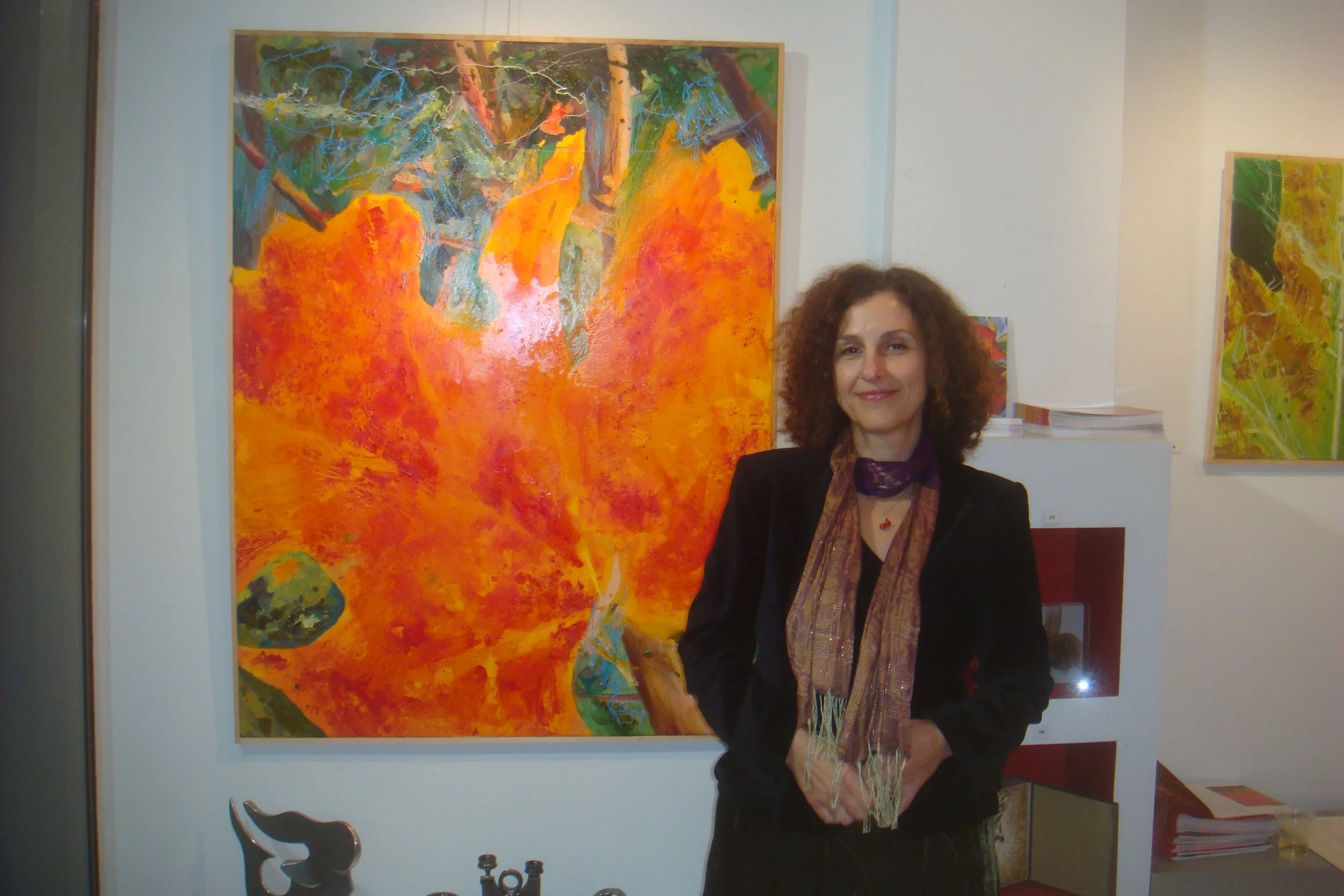
Abstraction in the painting of Peny Manavi is not general. She retains from representationalism as many features as are necessary for her to make reference to the recognisability of motifs and themes, without ever being tied down to these. Subject and space are unified, as are light and colour, as one defines the other; but the most interesting thing in her paintings is that they show us a kind of 'mapping' which reveals, as it were, veins and arteries, tissues and joints of an organic body which is constantly in motion, a state of flux, and mutation.
Memories and feelings, experiences and impressions, gestures and glances, reflections and unexpected occurrences make their appearance transubstantiated into a joyful reality, which, nevertheless, makes no attempt to hide its dark places or mysteries. The natural convention takes on a supernatural permeation in this artistic 'radioscopy', in which the transparency brings to light all kinds of qualitative osmosis of the colour tones and of the quantitative transformations of matter into energy, as well as of the 'action' of the art on a density of levels of the style itself.
With her blossoms and foliage, branches and stems, Peny Manavi embodies the feel of times and seasons, but also of emotions which are aroused by means of certain stimuli, provided both by life and the biodiversity of Nature - the Nature which we experience, and that which we convey within ourselves, given that they are the two sides of the same coin.
Each of the artist's works serves as a pilot and oscillator for sensitisation and self-knowledge as to the tiny and the very great things which define us, hold us together, and shape us. Her gesture of expression becomes a rhythm and a way of looking, a mood and a mode of introspection, as well as of contemplation both of the visible and, even more so, of the unseen aspects of a multi-level reality which undergoes a constant process of transformation, and which it traces, without, however, robbing it of its magic. Through the fluidity of the distances and their alternations, Nature, from being an object of art, becomes a subject and a puzzling enigma of life, an experience and transcendence, a spiritual exercise and advocacy of the fragility and greatness of the unembellished but marvellous things in the world we are looking at by means of our psychodynamic 'fingerprints' which on each occasion give it shape.
Athena Schina
Critic and Art Historian
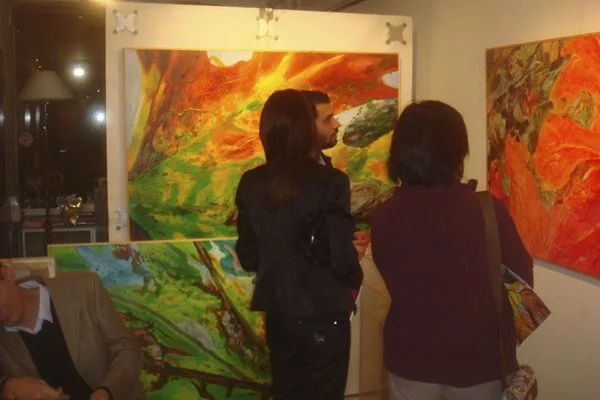
INSTALLATION VIEWS